

Handcrafted vs Mass Produced Wax Melts: 2026 Comparison
Table of Contents
- Handcrafted vs Mass Produced Wax Melts: The Quick Comparison
- Wax Type and Ingredient Quality: Soy Wax vs Paraffin Wax
- Wax Melt Scent Throw Comparison: Cold Throw vs Hot Throw
- Burn Time, Wax Pool Behavior, and Consistency Between Batches
- Health and Safety: Phthalate-Free Oils and Canadian Rules
- How to Choose High-Quality Wax Melts: A Practical Checklist
- Cost Per Hour, Packaging, and the Circular Economy
- Frequently Asked Questions
Last Updated: September 27, 2026
Handcrafted vs Mass Produced Wax Melts: The Quick Comparison
Handcrafted vs mass produced wax melts comes down to how much control the maker has over wax type, fragrance load, and pour consistency. Handcrafted wax melts are produced in small batches with tighter oversight of each pour, while mass-produced melts run through industrial manufacturing lines built for volume. This guide from Ruby Creek Wax Co. breaks down where the two paths actually diverge, and where the marketing hype overshadows the real differences.
The gap shows up in three places: what goes into the wax, how strongly it throws scent, and how reliably each cube performs from one batch to the next. Below, we'll show you exactly how to read a label, judge scent throw before you buy, and decide which option fits your home and your budget.
::::tip The fastest quality check is the ingredient panel, not the front label. "Soy wax blend" tells you almost nothing. "100% soy wax" with a named fragrance source tells you the maker is willing to be specific. ::::
| Factor | Handcrafted Wax Melts | Mass Produced Wax Melts |
|---|---|---|
| Wax base | Often 100% soy or beeswax | Frequently paraffin or blends |
| Batch size | Small-batch pours | Continuous industrial runs |
| Scent load | Higher fragrance oil ratio typical | Optimized for cost per unit |
| Consistency | Varies slightly batch to batch | Highly uniform, less nuanced |
| Packaging | Often recyclable, gift-ready | Often plastic clamshells |
| Price per cube | Higher upfront | Lower upfront |
Wax Type and Ingredient Quality: Soy Wax vs Paraffin Wax
Soy wax is a vegetable wax derived from soybean oil, and it typically burns cooler and cleaner than paraffin wax, which is a petroleum byproduct. That single distinction drives most of the quality conversation in wax melts. But the real difference lives at the molecular level, and understanding it explains why two melts that look identical can perform nothing alike.
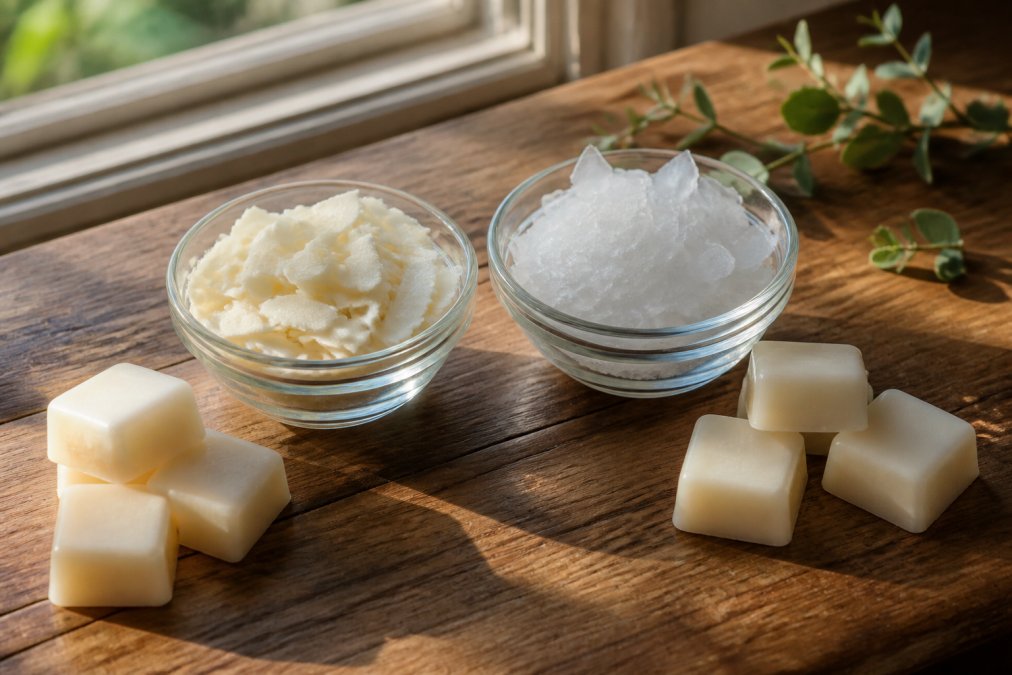
Paraffin wax is a mixture of straight-chain hydrocarbons with carbon backbones ranging from roughly C20 to C40. Those chains pack tightly, which gives paraffin a high melting point and a dense crystalline structure. When heated, paraffin releases fragrance molecules aggressively because its tight lattice pushes volatiles out quickly. That is why mass-produced melts often smell overpowering on the shelf and then fade fast once melted.
Soy wax is a triglyceride, a glycerol backbone esterified with three fatty acids. Those fatty acids vary in chain length and saturation, which creates a looser, more irregular crystal structure. That irregularity means soy wax melts at a lower temperature, holds fragrance more gently, and releases it over a longer window. The trade-off is that soy wax can be softer and more prone to frosting or sweating in temperature swings.
Beeswax is a complex mixture of esters, hydrocarbons, and fatty acids with a higher melting point than soy.
| Wax Type | Base Chemistry | Melt Point Range | Fragrance Release Pattern |
|---|---|---|---|
| Paraffin | Straight-chain hydrocarbons (C20-C40) | Higher | Fast, aggressive, short-lived |
| Soy | Triglycerides with mixed fatty acids | Lower | Gradual, steady, longer window |
| Beeswax | Esters, hydrocarbons, fatty acids | Highest | Slow start, deep bloom |
| Coconut | Hydrogenated coconut oil blend | Mid-range | Creamy, even, extended |
What the Label Tells You About Fragrance Oil and Essential Oils
Fragrance oil and essential oils are not interchangeable, and the label usually tells you which one you're getting. Fragrance oils are lab-formulated blends that can be built to smell like almost anything. Essential oils are plant-derived and usually subtler, with a shorter scent life.
Wax Melt Scent Throw Comparison: Cold Throw vs Hot Throw
A simple test: melt one cube in a standard warmer and note how long the scent lasts across a room. If it fades within the first hour, the fragrance load is thin regardless of what the label claims.
Burn Time, Wax Pool Behavior, and Consistency Between Batches
Burn time per cube depends on wax type, cube size, and warmer temperature. Most quality soy melts run in the 6-7 hour range per cube under a standard tealight or electric warmer, though a hotter warmer will shorten that. But burn time is only half the story. The other half is how the wax pool behaves, and that comes down to wick technology and wax formulation.
A melt that pools evenly across the full surface will release fragrance for its entire burn time. A melt that tunnels will fade early no matter how much fragrance oil it contains.
Health and Safety: Phthalate-Free Oils and Canadian Rules
Wax melts sold in Canada fall under consumer product safety oversight, and makers are expected to avoid restricted substances in fragrance formulations. Phthalates, a class of chemicals historically used to carry fragrance, are the ingredient most buyers ask about first. Phthalate-free fragrance oil means the maker has chosen a formulation without that carrier.
Soot Emission and Indoor Air Quality
Soot emission is lower in soy and beeswax melts than in paraffin-heavy alternatives, largely because they burn at lower temperatures. That doesn't make any melt "soot-free," but it does mean less black residue on your warmer and, in most homes, a cleaner scent experience.
Never melt wax on a stovetop or over an open flame. Use a purpose-built warmer only. Overheating is the most common cause of scorched wax and a ruined warmer. ::::
How to Choose High-Quality Wax Melts: A Practical Checklist
Knowing how to choose high-quality wax melts comes down to a short list of checks you can run before spending anything. Use this checklist every time:
- Wax base is named specifically (100% soy, beeswax, or a stated blend)
- Fragrance is listed as phthalate-free or paraben-free
- Burn time per cube is stated in hours
- Cube size and weight are listed (2oz containers are a common standard)
- Container is recyclable or refillable
- Maker describes scent notes rather than just a category name
- Reviews mention hot throw, not just packaging
- Return policy is visible before checkout
Cost Per Hour, Packaging, and the Circular Economy
Cost per hour is the honest way to compare wax melts, not sticker price. A cube that runs 6-7 hours costs a fraction of that per hour of scent, and a cheap cube that fades in 90 minutes is the expensive option in practice.
| Buying Approach | What You Pay For | Long-Term Trade-Off |
|---|---|---|
| Cheapest per cube | Volume and low fragrance load | Shorter scent life, more repurchasing |
| Mid-range handcrafted | Named wax, stated burn time | Slightly higher upfront cost |
| Gift-ready boxed sets | Curated scents, recyclable packaging | Best value when gifting multiple people |
Frequently Asked Questions
What are the primary differences between handcrafted wax melts and mass-produced versions?
Handcrafted wax melts are poured in small batches, so the maker controls wax type, fragrance load, and cure time. Mass-produced versions run on industrial manufacturing lines that prioritize volume and shelf life, often using paraffin wax and higher fragrance loads to compensate for cheaper base material. In practice, the difference shows up in how evenly the melt performs across the whole pack, not just the first cube. Small-batch melts tend to smell the same on cube one and cube ten, while mass-produced packs can vary between batches.
Why do handcrafted wax melts often provide a superior scent throw?
Scent throw depends on fragrance load and how well the wax carries it. Handcrafted melts made with 100% soy wax and a proper cure time release fragrance steadily as the wax pool forms, which gives a stronger hot throw over the full 6-7 hour burn. Mass-produced melts sometimes add synthetic boosters that smell sharp at first and fade fast. Cold throw also matters: a handcrafted melt usually smells true in the package, so you know what you are getting before you plug in the warmer.
How can you identify high-quality, handcrafted wax melts?
Start with the label. Look for the wax type stated plainly (soy wax, beeswax, or a documented blend), a fragrance disclosure such as phthalate-free, and a stated burn time per cube. Check the container: recyclable packaging and a 2oz size with a clear scent name are good signs. Then test cold throw by smelling the melt unopened. If it smells weak or chemical in the package, the hot throw will likely disappoint too. Small-batch makers usually list scent notes and cure details, which mass-produced brands rarely do.
Are handcrafted wax melts more environmentally friendly than mass-produced alternatives?
Often, yes, but it depends on the specifics. Soy wax is renewable and biodegradable, and handcrafted makers frequently use recyclable containers, which lowers the carbon footprint compared to plastic-clamshell mass production. That said, environmental impact also comes from shipping distance and packaging volume, so a local small-batch maker has an edge over an imported industrial product. Look for renewable wax, recyclable containers, and a maker who states where the wax comes from rather than relying on a general sustainability claim.
How do I know these melts will actually have a strong scent throw before I buy?
Ask three things: the wax type, the fragrance load, and the burn time per cube. A 100% soy wax melt with a stated 6-7 hour burn time per cube and phthalate-free fragrance oil is a reliable starting point. Cold throw is your best pre-purchase test, so buy a single melt first and smell it unopened. If it fills the room from the package, the hot throw will usually follow. If the scent is faint or smells synthetic, expect the same once warmed.
The real challenge with handcrafted vs mass produced wax melts isn't picking a side. It's finding a maker who tells you what's in the wax, states the burn time, and stands behind the scent once it's melting in your living room. Ruby Creek Wax Co. hand-pours 100% soy wax melts in small batches, lists paraben- and phthalate-free fragrance oils, and packages every collection in recyclable containers. Browse the full range and find the scent that fits your space.